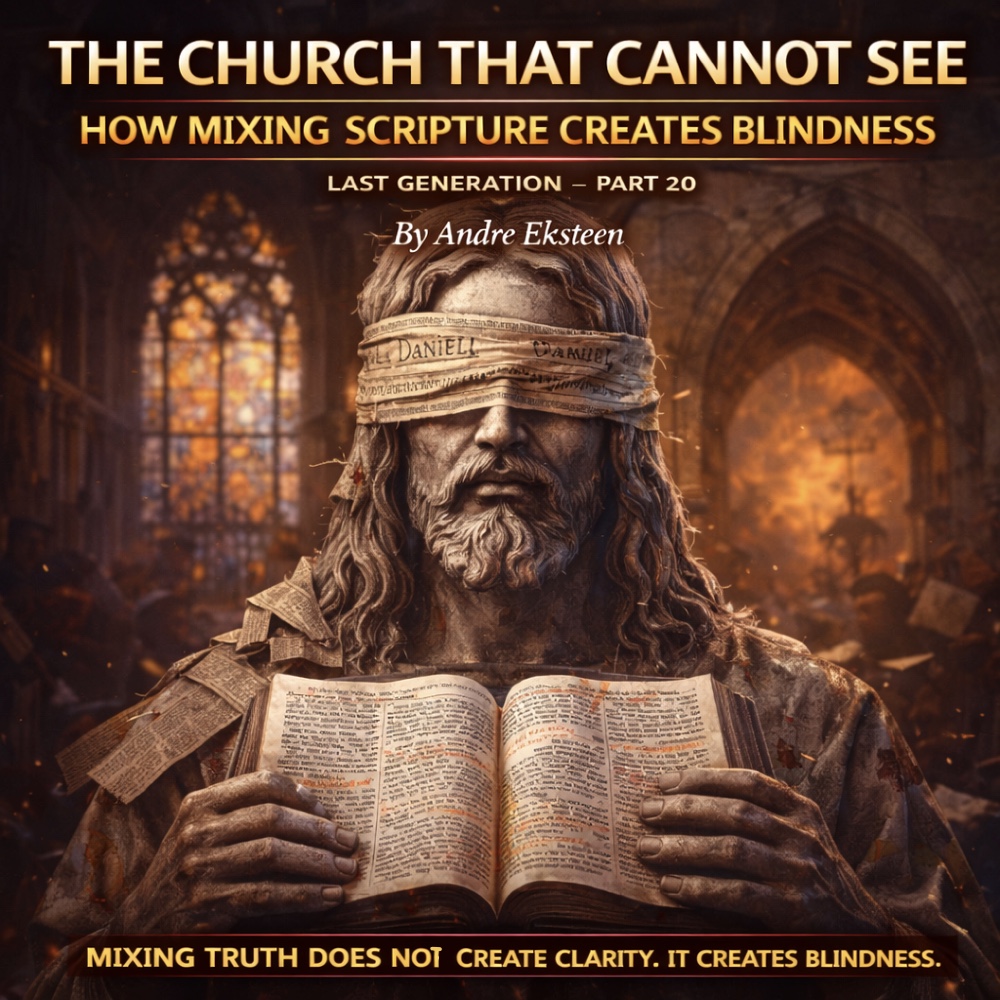
The Church That Cannot See: How Mixing Scripture Creates Blindness – Last Generation Part 20
By Andre Eksteen
We have spoken about deception throughout this series. We have traced its mechanism — not the removal of truth but the mixing of it. We have seen how it operates in popular end-times teaching, how it produces the specific cycle of confident prediction and failed expectation that has repeated across decades without producing the kind of self-correction honest inquiry would require. We have named it in the context of specific passages and specific frameworks. But now we need to deal with something far closer to home. Not deception as a general danger. Not deception as what happens to the world. The specific condition of the Church — the community that holds Scripture, that studies prophecy, that cares about the end times — and whether it is seeing clearly or seeing through something.
Because if the Church is seeing through a lens rather than seeing the text itself, then its blindness is the most consequential blindness of all. The world does not claim to see clearly. The world is not surprised when it misreads spiritual realities. But the Church claims to hold the truth. The Church claims to read the Bible correctly. When it is wrong, it is wrong with authority. It teaches its error to those who trust it. It passes its misaligned frameworks to the next generation as if they were the text itself. And the people who receive those frameworks — who learned them in church, who were taught them by people they trusted, who have held them for decades — do not know the difference between what is written and what has been added. That is blindness. Not stupidity. Not faithlessness. Blindness. And blindness in a person who believes they see is the most resistant kind to correction.
How the Church Got Here
To understand the condition of the Church on end-times questions, you need to understand how teaching passes through generations. A teacher reads Scripture, develops a framework, teaches it with confidence. Students receive the framework and teach it to the next generation. Over time, the framework becomes the interpretive lens through which students approach the Scripture — which means they no longer read Scripture and arrive at the framework. They read the framework into Scripture before they open it. The text and the tradition have become indistinguishable to them because they have never known a version of the text that existed outside the tradition.
This is a process that happens in every theological tradition, not only in end-times teaching. But it happens with particular force in end-times teaching because that domain has been particularly productive of elaborate, internally coherent systems — systems that feel complete, that answer the questions you bring to them, that connect passages across multiple books into an apparently seamless picture. The more elaborate and internally coherent a system becomes, the more it functions as its own confirmation — every element seems to support every other element, the whole thing hangs together, and the person inside it cannot imagine how anyone reading the same texts could arrive at a different conclusion.
Dispensationalism — the dominant end-times framework in evangelical and fundamentalist Christianity for over a century — is the clearest example of this. It is a sophisticated, internally coherent system that connects passages from Daniel, Matthew 24, 1 and 2 Thessalonians, and Revelation into a specific sequence of future events: the rapture, the seven-year tribulation period divided at its midpoint by the abomination of desolation, the reign of the Antichrist, the Battle of Armageddon, the return of Christ, and the Millennium. It has specific things to say about the role of Israel, the identity of the Antichrist, the timing of the rapture relative to the tribulation, and the character of each stage of the sequence.
Now this framework is not built from nothing. Every element of it is drawn from Scripture. The passages it uses are real. The connections it makes are often genuine correspondences. But the specific configuration — the gap between the sixty-ninth and seventieth week of Daniel, the pre-tribulation rapture, the seven-year tribulation as a distinct period, the specific sequence of events — is not stated in any of the source texts. It is the product of a system of inference applied to those texts. And the inferences were made, in significant measure, in the nineteenth century by a small number of teachers whose specific readings became the dominant tradition through the influence of the Scofield Reference Bible and later of Darby and his followers.
The people who operate within this framework today are not bad readers. Many of them are careful, studious, genuinely committed to Scripture. But they are reading Scripture through a tradition that was established in a specific historical period, by specific teachers, and that has been transmitted with a confidence that has increasingly made it indistinguishable from the text itself. When a student of this tradition reads Matthew 24, they are not reading Matthew 24. They are reading the Scofield notes on Matthew 24, even if they have never opened the Scofield Bible. The tradition has become the lens. And the lens shapes what they can see.
The Specific Blindnesses This Produces
Now let me be specific about what the mixing of Scripture with extrabiblical framework produces in terms of actual interpretive blindness, because the argument is not abstract. There are specific things that the dominant tradition makes it difficult or impossible to see.
The first is the plain meaning of Matthew 24:34 in relation to its context. As we established in Parts 1 through 3, “this generation” in Matthew 24 is most naturally read as a group defined by what they witness — the generation that sees all these things. That reading follows the text, is consistent with how Jesus uses genea throughout Matthew, and does not require importing anything from outside the passage. But the dominant tradition has so thoroughly identified this verse with a generation counting from 1948 that the plain reading is genuinely invisible to most people who have been formed within that tradition. They read “this generation” and automatically think “40 or 70 years from 1948” without recognising that the text never says that. The tradition has replaced the text.
The second is the character of the fig tree parable. As we established in Part 13, the fig tree in Matthew 24:32-33 is explicitly called a parable and is used to illustrate a principle of seasonal recognition. Luke’s parallel version includes “all the trees,” not just the fig tree specifically. The plain reading is a natural illustration about recognising seasons from visible indicators. But the tradition has so thoroughly identified the fig tree with Israel that most readers from within that tradition find it impossible to consider that the identification might not be in the text. The symbolic identification feels like the text because it has been transmitted alongside the text for so long.
The third is the treatment of Daniel’s seventy weeks. The gap between the sixty-ninth and seventieth week — the insertion of an unspecified interval of church history between the two — is presented in the dominant tradition as a clear reading of Daniel 9. But it is an inference, not a statement. The text of Daniel 9 does not include a gap. The gap is inserted to resolve a chronological problem that the system encounters when it tries to make the seventieth week a future seven-year tribulation period. If you read Daniel 9 without the system, the gap is not there. But within the system, it is so thoroughly assumed that most people who hold the tradition cannot read Daniel 9 without it.
The fourth is the relationship between Israel and the church in the prophetic picture. The dominant tradition insists on a sharp distinction — Israel and the church have separate futures, separate programmes, separate promises. That distinction drives the entire dispensationalist framework. But Paul in Romans 9-11 presents a picture in which Gentile believers are grafted into the same olive tree as Jewish believers, in which the distinction between Jew and Gentile in terms of salvation is fully abolished in Christ, and in which the future of Israel and the future of the church are intertwined rather than separate. You can hold the dispensationalist distinction and read Romans 9-11. But you cannot follow Romans 9-11 carefully and arrive at the sharp Israel-church distinction without imposing it from outside the passage.
Now the point of naming these specific blindnesses is not to demolish the dispensationalist tradition as entirely worthless. It captured real elements of the prophetic picture that replacement theology missed entirely — particularly the reality of a future for Israel as a distinct people. But it also generated specific interpretive blindnesses that have produced the predictive failures, the false certainties, and the misaligned frameworks we have documented throughout this series. And those blindnesses are not self-correcting because they are built into the tradition and transmitted with the tradition’s authority.
The Laodicea Warning and Its Application
Now let me connect this to a passage that has direct bearing on the condition of the Church in the present period, and that most end-times teaching applies to the world rather than to the community of faith — which is itself an example of the blindness we are describing.
Revelation 3:14-22 contains Jesus’ message to the church of Laodicea — the last of the seven churches in Revelation 2 and 3. The Laodicean church is not described as actively evil or openly apostate. It is described as lukewarm — neither cold nor hot, making Jesus say He will spew them out of His mouth. And the diagnosis Jesus gives for the condition is striking: “Because thou sayest, I am rich, and increased with goods, and have need of nothing; and knowest not that thou art wretched, and miserable, and poor, and blind, and naked” (Revelation 3:17).
The Laodicean church does not know it is blind. That is the specific condition described. They believe they see. They have a confident self-assessment — rich, increased with goods, in need of nothing. They have resources, access, teaching, frameworks, confidence. And Jesus’ diagnosis is that in the middle of all of that abundance, they are blind. Not because truth is absent. Because they are so satisfied with what they have that they have stopped actually looking.
Now apply that to the present condition of the Church on end-times questions. Western Christianity, particularly in its evangelical and fundamentalist expressions, has more access to biblical teaching, more commentaries, more study resources, more prophetic literature, more Bible translations, and more confident teachers than any previous generation in history. By the Laodicean self-assessment — rich, increased with goods — it is doing well. But the actual condition — the division, the conflicting frameworks, the repeated predictive failures, the inability to arrive at convergent understanding of what the text actually says — suggests a blindness that operates in the middle of abundance rather than in spite of it. The abundance is part of the problem. The multiplicity of confident frameworks is part of what makes it harder, not easier, to find the signal.
The remedy Jesus prescribes for Laodicea is the same remedy this series has been advocating: “I counsel thee to buy of me gold tried in the fire, that thou mayest be rich; and white raiment, that thou mayest be clothed, and that the shame of thy nakedness do not appear; and anoint thine eyes with eyesalve, that thou mayest see” (Revelation 3:18). Eye salve. To see. The remedy for the blindness that comes with confident self-sufficiency is not more information. It is the kind of humility that is willing to admit you do not see clearly and to ask for the sight that the self-confident will not ask for because they already believe they have it.
This is not a comfortable application. But it is the application the text makes. And a series that has spent twenty parts insisting that the Church return to what is written rather than to what has been assumed must apply that same insistence here, even when the application points at the reader rather than at a distant other.
How Mixed Teaching Spreads and Hardens
Now let me trace the mechanism by which mixed teaching — teaching that combines genuine scriptural insight with extrabiblical inference and presents the combination as what the text says — spreads through the church and eventually becomes impossible to question without social cost.
The initial stage is the teacher. A serious reader develops a framework. The framework captures genuine insights from the text. It answers real questions. It provides a coherent picture of how the prophetic passages fit together. The teacher communicates with genuine conviction and is received as authoritative within their community. Their framework spreads because it meets a real need — the need for order, coherence, and confidence in the face of prophetic material that can feel overwhelming in its scope and complexity.
The second stage is institutionalisation. The framework gets written into study Bibles, commentary series, Bible college curricula, church constitutions, and statement of faith documents. At this stage it stops being “what teacher X believes” and starts being “what the Bible teaches.” The institutionalised framework carries authority that is now attributed to the Scripture itself rather than to the teacher who developed it. People who receive the framework at this stage do not experience it as a tradition — they experience it as the plain reading of Scripture.
The third stage is social entrenchment. The framework becomes associated with community identity. To question it is to question not just a theological position but the community that holds it. People who raise questions about the framework — who point out that specific elements are inferences rather than statements, that specific dates have passed without fulfilment, that specific identifications have proven wrong — are often treated as threats to the community rather than as fellow seekers after truth. The social cost of questioning becomes high enough that most people within the tradition do not question publicly, even when they have private doubts.
The fourth stage is defensive apologetics. When the framework’s predictions fail, the response is not to examine the framework but to defend it. New interpretations are offered for why the predictions did not work out as expected. Alternative calculations are proposed. The evidence that would correct the framework is absorbed and neutralised rather than received and applied. The framework becomes unfalsifiable in practice, even if theoretically the people who hold it would say they are open to correction.
Now ask whether this pattern describes the dominant end-times tradition in evangelical Christianity over the past century. The answer is yes, in significant detail. The tradition that emerged from Darby and Scofield in the nineteenth century, institutionalised in the Scofield Reference Bible, spread through Bible colleges and fundamentalist churches, popularised by Hal Lindsey and Tim LaHaye in the twentieth century, has followed exactly this pattern. Its predictions have failed. Its specific identifications have been wrong. Its timelines have required repeated adjustment. And the response, consistently, has been adjustment of the variables rather than examination of the framework.
That pattern is not unique to dispensationalism. It is the pattern of any tradition that has become more committed to its own coherence than to the correction the text would bring. And recognising the pattern in the dominant tradition of one’s own community is uncomfortable enough that most people do not do it. But the warning Jesus gave in Matthew 24 — and the warning He gave to Laodicea — require exactly that kind of honest self-examination. The person who loves truth more than they love their tradition’s coherence is the one positioned to see. And that person, in the present landscape, is rarer than it should be.
The Church that cannot see is not the Church that lacks Scripture. It is the Church that has stopped letting Scripture correct it. And the correction this series has been attempting — patient, textual, structural — is available to any reader willing to receive it. Not to demolish what they have received. To test it. And to build on what survives the testing. That is what the text has always asked. It is asking it still.
What Returning to the Text Requires
Now let me be direct about what it actually requires to return to the text rather than to a tradition, because it is harder than it sounds. It requires something most people are unwilling to do: hold your inheritance loosely enough to have it corrected.
Most people receive their theological frameworks in contexts that make them load-bearing. They receive them in church, from pastors they trust, alongside their conversion experience, woven into the community that has been formative for them. To question the framework is not, in that context, merely an intellectual exercise. It feels like a betrayal of community, a questioning of trusted teachers, a destabilisation of things that have been foundational. The resistance to re-examining inherited end-times frameworks is not primarily intellectual. It is relational and emotional.
But the text itself demands it. Jesus’ first instruction in Matthew 24 was not “trust your teachers about deception.” It was “take heed that no man deceive you.” The primary responsibility for discernment rests with the individual reader, not with the tradition. The Bereans in Acts 17:11 were commended because they “searched the scriptures daily, whether those things were so” — checking the teaching they received against the text, even when the teacher was Paul. If the Bereans were right to check Paul’s teaching against the text, every reader is right to check their tradition against the text. And if the tradition does not hold up — if it requires assumptions the text does not make, inferences the text does not support, configurations the text does not establish — then it should be held loosely rather than defended.
Now this is not a call to theological anarchism — the idea that every individual can read the Bible in isolation and arrive at whatever conclusion they like, and all conclusions are equally valid. The community of faith has a role in testing and correcting individual interpretation. The accumulated wisdom of serious readers across centuries is genuinely valuable. The tradition is not worthless just because it is a tradition.
But there is a difference between the accumulated wisdom of the tradition and the specific doctrines that have been built on specific extrabiblical inferences. The tradition’s accumulated wisdom about who Jesus is, what the gospel means, what faithfulness looks like in ordinary life — that wisdom has been tested over centuries and has broad cross-traditional agreement. The specific prophetic configurations — the gap theory, the pre-tribulation rapture, the Israel-church distinction, the generation-length calculation from 1948 — these are specific doctrines that emerged in a narrow historical window and have remained contested among serious readers ever since. They deserve to be held with the kind of tentativeness appropriate to their actual textual foundation — which is inference, not statement.
The Test: Can You Be Corrected?
Let me close this part with a practical test that applies to every reader of this series, including me. The test of whether you are reading the text or reading a tradition is simple: can you be corrected by the text?
If someone shows you from the text that a specific element of your framework is not actually stated there — that it is an inference or an assumption imported from outside — can you receive that? Can you hold your framework loosely enough to say, “I may have been wrong about this specific point”? Or does the investment in the framework make that reception impossible?
The person who cannot be corrected by the text is not reading the text. They are defending it — defending their version of it, which has become indistinguishable from the text itself in their experience. That person is, in the precise sense Jesus described, blind. Not because the light is absent. Because they are seeing through something that filters it.
The person who can be corrected — who holds their framework loosely enough to follow the text even when it disrupts the framework — is the one who is actually in a position to see. Not to see everything immediately. Not to have all the answers. But to be in a process of increasing clarity that is responsive to what is actually written rather than to what has been transmitted.
That is what this series has been calling for from Part 1. Return to the text. Follow the sequence. Remove the assumptions. Hold the framework loosely. And trust that the clarity Daniel described emerging at the time of the end is available to those who approach it with that posture — not to those who have the most elaborate system, but to those who are willing to see.
The last generation will require it. The deception surrounding the events they will witness will be the strongest in human history. The only protection against it is a posture that is more committed to what is written than to what has been inherited. And that posture can be built now, in the quiet of careful reading, before the pressure makes it harder to maintain.
That preparation is what this series has been for.